The Waltz by Tchaikovsky: Lesson Ideas
| Site: | ABRSM: Teacher Hub |
| Course: | The Waltz by Tchaikovsky: Lesson Ideas |
| Book: | The Waltz by Tchaikovsky: Lesson Ideas |
| Printed by: | Guest user |
| Date: | Saturday, 4 April 2026, 5:24 AM |
1. Warm Up Exercises
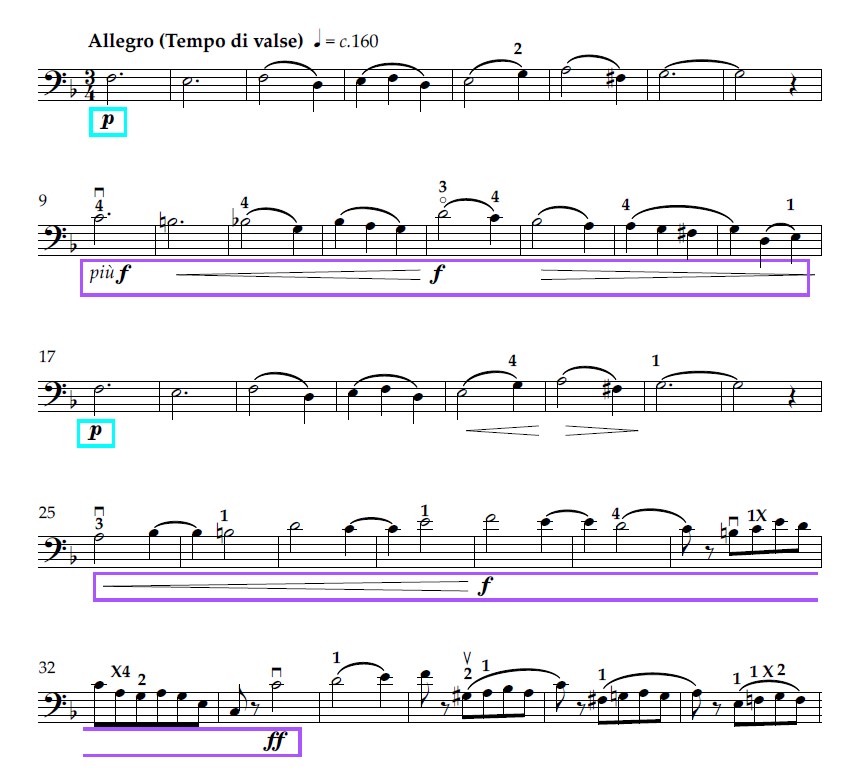
Meet Ana! From an early age Ana developed a strong passion for teaching and since 2008 she has been teaching cello and conducting string orchestras at different independent schools and institutions in Berkshire. In this resource Ana shares some ideas about teaching The Waltz from Sleeping Beauty from our Grade 3 syllabus.Ask your pupil to identify the highest and lowest notes in the piece and establish how many octaves you are going to play for the scale of the main key. In this case I would advise my pupil to play F major two octaves, as the highest note is F (Grade 3 onwards) and probably D minor harmonic/melodic 2 octaves (Grade 3 onwards) as the relative minor as well, as the lowest note in the piece is D on the C string.
Improvisation
Looking at the rhythm pattern at the beginning of the first phrase, I would ask my pupil to do a short improvisation with the notes of the arpeggio fitting in with the following rhythm:

Make sure you discuss the use of the bow and explore the different dynamics present with this pattern in the piece, Piano and Forte. Also ask your pupil to shape the improvisation to sound like a waltz by leaning on the strong beat of the bar.
Vibrato Warm-up
At this stage of the pupil’s playing, vibrato should be a skill being developed and slowly consolidated into their technique. Use the same rhythm pattern to explore Vibrato with all four fingers.
2. Pitch
The development of the shifting techniqueThe understanding of the shifting technique in this piece is very important as a wide range of positions are present. All instrumental teachers know the difficulties and consequences of fingering writing in music, when these are excessive and on most of the notes. Pupils end up struggling with their music reading and the ability to decide their own fingerings when approaching a new piece of music. I came up with a strategy to help pupils identify positions and shifts without necessarily writing a lot of numbers on the notes:
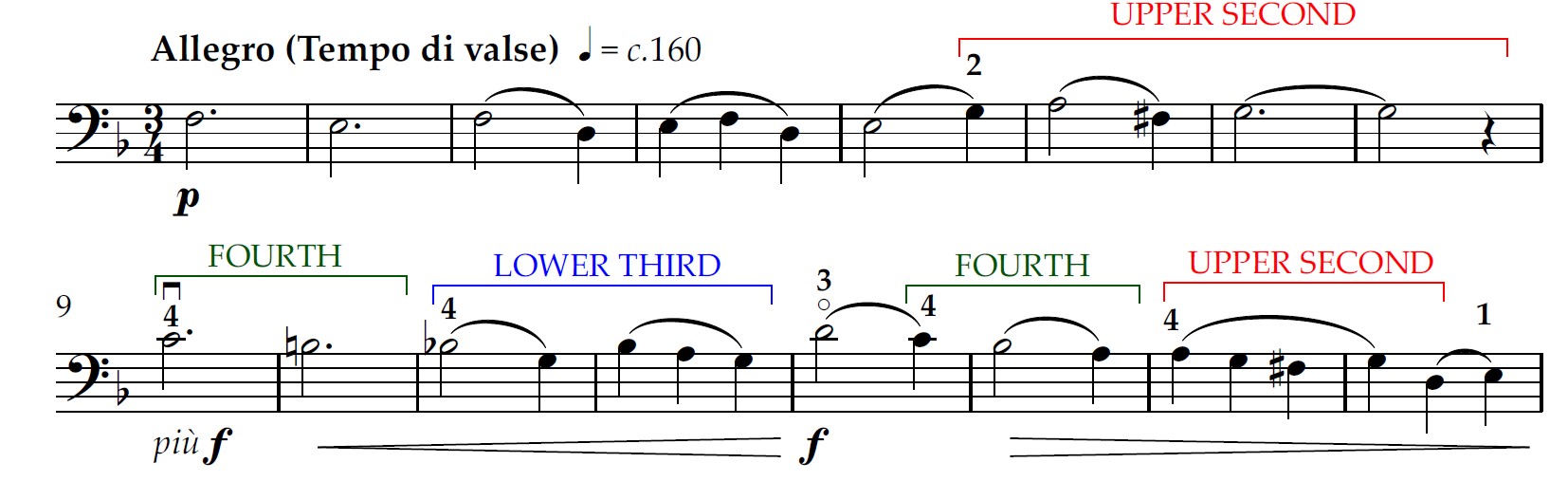
I keep a number of different erasable colour pens in my bag and together with my pupil we choose different colours for each position. By drawing brackets to contain the notes played in one position the pupil can preempt the shift and prepare for it properly, without hesitating too much about the fingering. I prefer this option when developing the understanding of the fingerboard’s geography, rather than writing a lot of numbers on the notes. This strategy is particularly useful for those pupils that can relate well to visual help in their music.
Same Finger Shifting exercise
On bar 31 we have a clear example of the need to develop the ability to shift with the same finger correctly so as to prepare a new position, in this case with an extension.
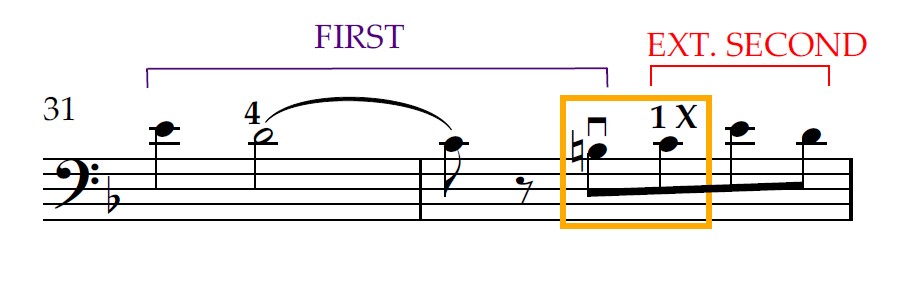
Choose a note and a finger on any string. Ask your pupil to play the note and sing it. Follow up by singing a major scales from that note going up (at least 5 notes if an is octave not possible). Then ask your pupil to play the scale with only the one chosen finger by shifting for each single note. This exercise is excellent for showing the preparation and anticipation needed in the movement as well as the concept of “weight into the string”.
3. Time
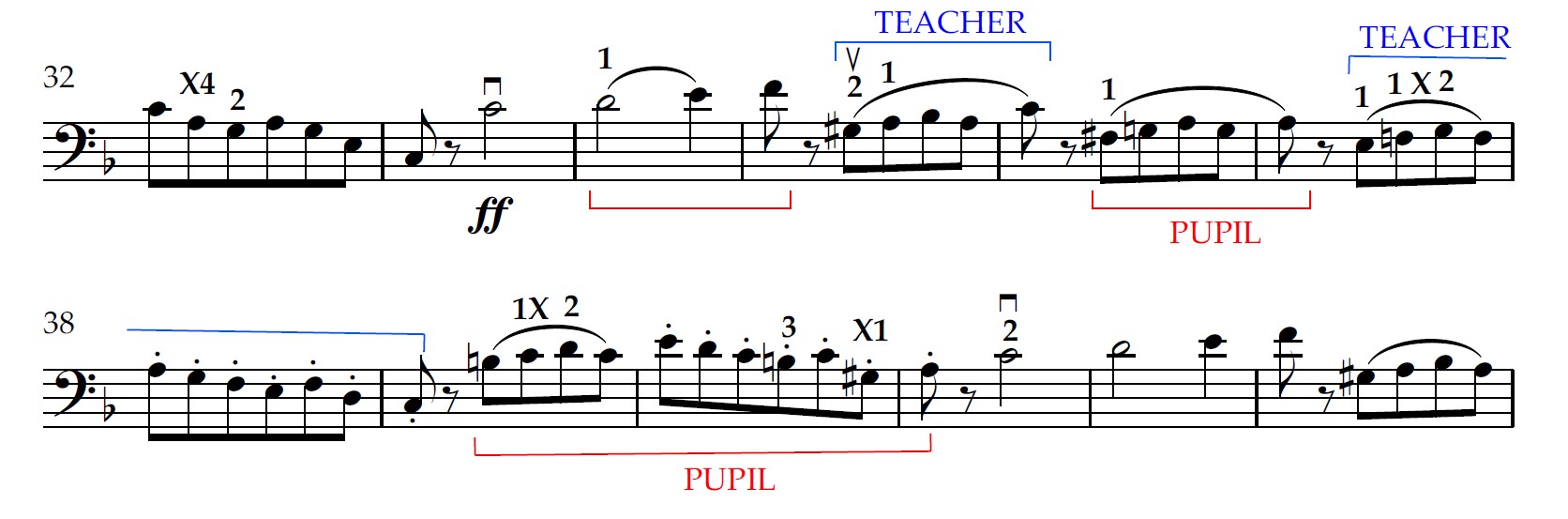
Sections that are particularly difficult rhythmically are the following: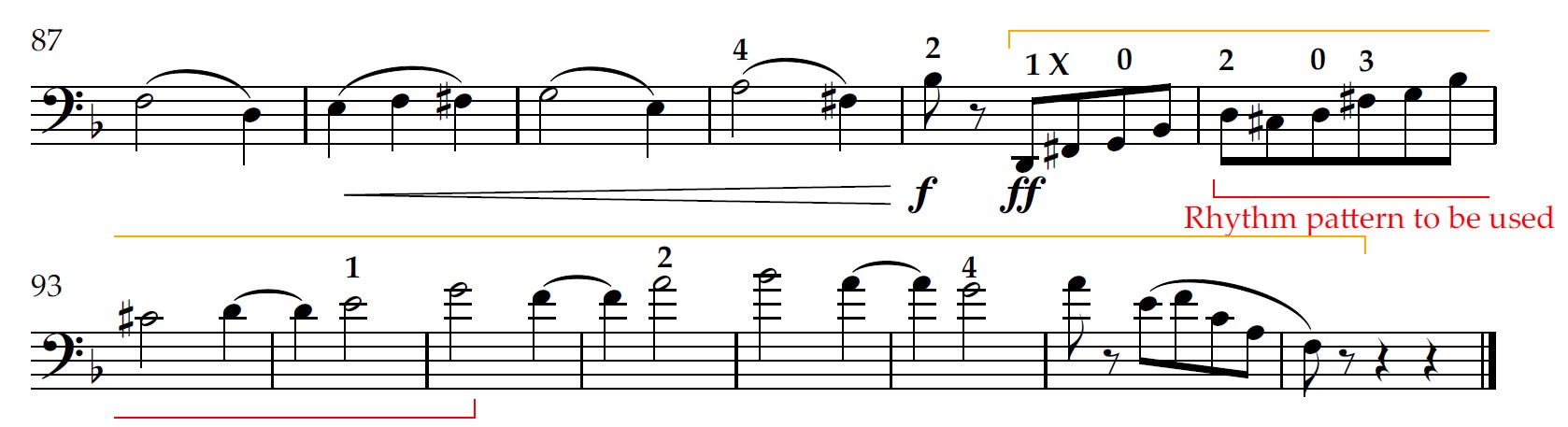
Sub-dividing in crotchets, use the rhythm pattern on F Major and play one note of the scale 6 quavers for bar 92 and the next note three minims for bars 93 and 94, etc you can do the same with the arpeggio.
Keeping the same pulse, alternate the following sections with your pupil by clapping the rhythm. When the piece is more secure, play the actual notes alternating the brackets and swapping places.
4. Tone
This piece requires smooth legato from bar 1 to bar 30 and then again from bar 69 to the end, while the middle section needs bow control for the detached/short staccato stroke alternated with slurs. Use the passage between bars 64 and 69 to practise your detached bow stroke, making sure both the up bow and down bow sound exactly the same, with the same start to the sound as well as length of note. Practise the coordination of both hands by stopping briefly the bow on the string before shifting to a new position. This exercise will be of great help for the fluidity of the passage!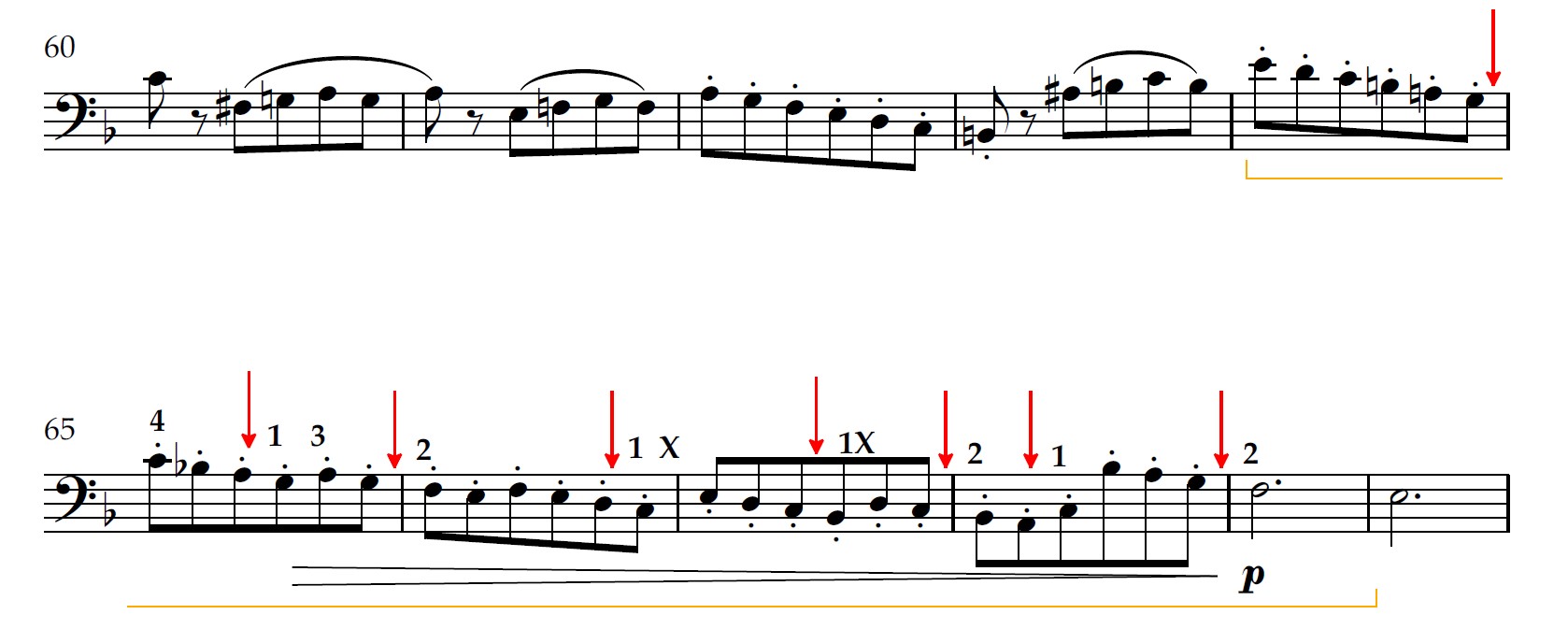
5. Shape
While working with your pupil explore the quality of the starting piano in the piece at bar 1. Making sure this piano is soft with a contact point close to the fingerboard will allow the following dynamics to be more expressive and contrasting, particularly from bar 25 onwards.